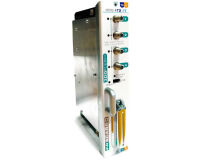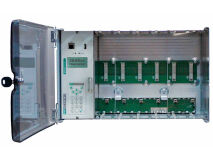
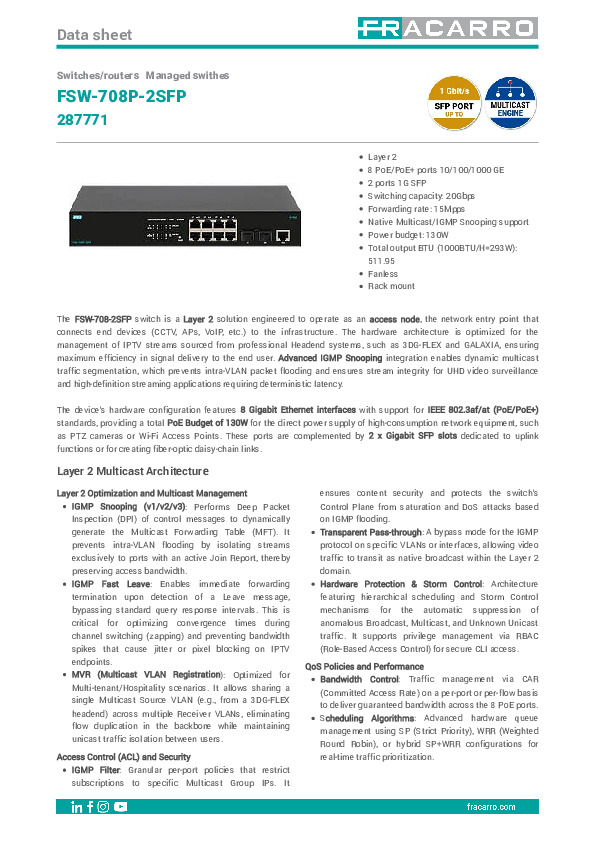
The FSW-708-2SFP switch is a Layer 2 solution engineered to operate as an access node, the network entry point that connects end devices (CCTV, APs, VoIP, etc.) to the infrastructure. The hardware architecture is optimized for the management of IPTV streams sourced from professional Headend systems, such as 3DG-FLEX and GALAXIA, ensuring maximum efficiency in signal delivery to the end user. Advanced IGMP Snooping integration enables dynamic multicast traffic segmentation, which prevents intra-VLAN packet flooding and ensures stream integrity for UHD video surveillance and high-definition streaming applications requiring deterministic latency.
The device's hardware configuration features 8 Gigabit Ethernet interfaces with support for IEEE 802.3af/at (PoE/PoE+) standards, providing a total PoE Budget of 130W for the direct power supply of high-consumption network equipment, such as PTZ cameras or Wi-Fi Access Points. These ports are complemented by 2 x Gigabit SFP slots dedicated to uplink functions or for creating fiber-optic daisy-chain links.
- Layer 2
- 8 PoE/PoE+ ports 10/100/1000 GE
- 2 ports 1G SFP
- Switching capacity: 20Gbps
- Forwarding rate: 15Mpps
- Native Multicast/IGMP Snooping support
- Power budget: 130W
- Total output BTU (1000BTU/H=293W): 511.95
- Fanless
- Rack mount
Layer 2 Optimisation and Multicast Management
IGMP Snooping (v1/v2/v3): Performs Deep Packet Inspection (DPI) of control messages to dynamically generate the Multicast Forwarding Table (MFT). It prevents intra-VLAN flooding by isolating streams exclusively to ports with an active Join Report, thereby preserving access bandwidth.
IGMP Fast Leave: Enables immediate forwarding termination upon detection of a Leave message, bypassing standard query response intervals. This is critical for optimizing convergence times during channel switching (zapping) and preventing bandwidth spikes that cause jitter or pixel blocking on IPTV endpoints.
MVR (Multicast VLAN Registration): Optimized for Multi-tenant/Hospitality scenarios. It allows sharing a single Multicast Source VLAN (e.g., from a 3DG-FLEX headend) across multiple Receiver VLANs, eliminating flow duplication in the backbone while maintaining unicast traffic isolation between users.
Access Control (ACL) and Security
IGMP Filter: Granular per-port policies that restrict subscriptions to specific Multicast Group IPs. It ensures content security and protects the switch's Control Plane from saturation and DoS attacks based on IGMP flooding.
Transparent Pass-through: A bypass mode for the IGMP protocol on specific VLANs or interfaces, allowing video traffic to transit as native broadcast within the Layer 2 domain.
Hardware Protection & Storm Control: Architecture featuring hierarchical scheduling and Storm Control mechanisms for the automatic suppression of anomalous Broadcast, Multicast, and Unknown Unicast traffic. It supports privilege management via RBAC (Role-Based Access Control) for secure CLI access.
QoS Policies and Performance
Bandwidth Control: Traffic management via CAR (Committed Access Rate) on a per-port or per-flow basis to deliver guaranteed bandwidth across the 8 PoE ports.
Scheduling Algorithms: Advanced hardware queue management using SP (Strict Priority), WRR (Weighted Round Robin), or hybrid SP+WRR configurations for real-time traffic prioritisation.